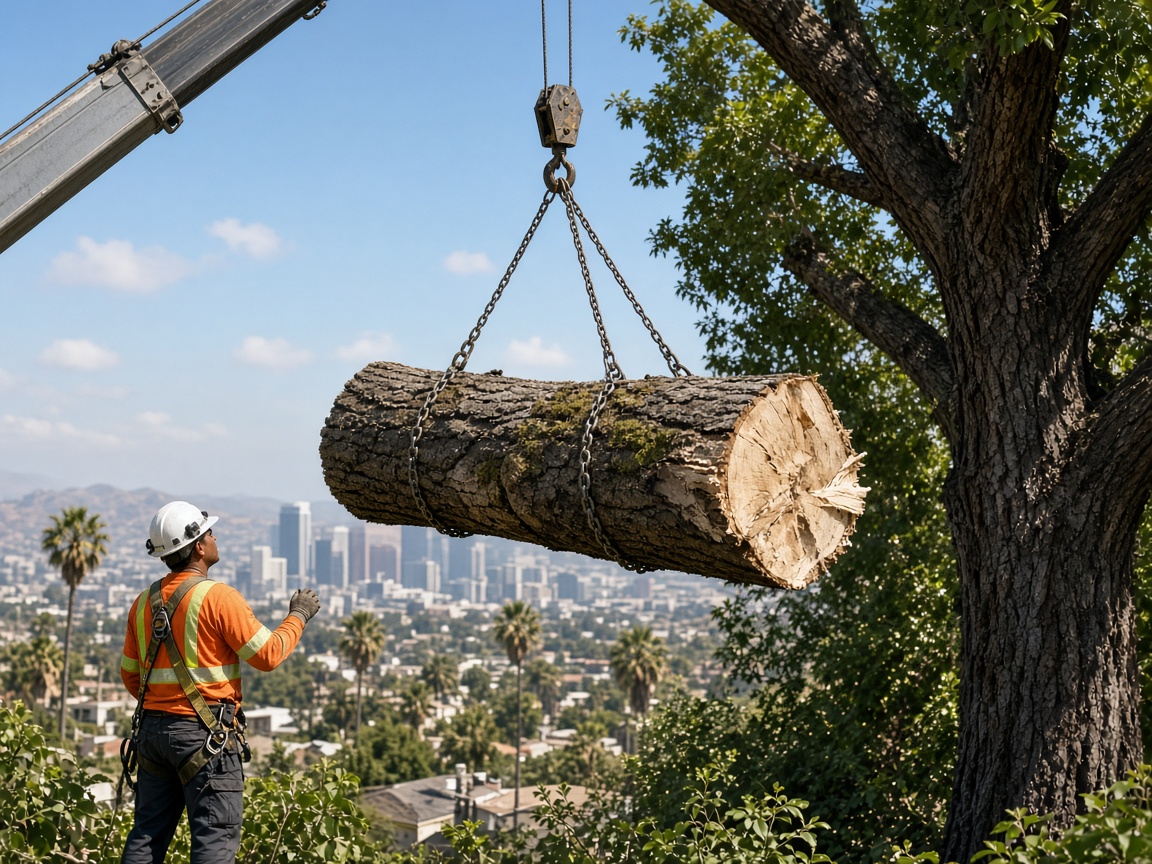
Tree removal in Los Angeles is rarely a simple fell-and-drop job. Lots are small, homes sit close to property lines, and most backyards have a pool, a detached garage or a neighbor’s roof inside the fall zone of any tree worth removing. That is why most of our removals come down in sections: a climber or bucket works from the top, each piece is tied off and lowered on a rope, and the trunk is taken down last in manageable rounds. When there is no room to lower wood safely — a 70-foot pine behind a Hancock Park house, a eucalyptus over a Glendale hillside home — we bring in a crane and lift sections out over the roof.
The trees we remove most across LA County are the ones that were planted for fast shade decades ago and have outgrown their space: Aleppo and Canary Island pines, blue gum and red gum eucalyptus, Indian laurel and rubber tree ficus, Chinese elm, silk oak, Brazilian pepper and overgrown Mexican fan palms. Ficus is the classic LA problem — shallow, aggressive roots that crack driveways, lift sidewalks and invade sewer laterals. Eucalyptus sheds limbs without warning in summer heat. Pines weakened by drought and bark beetles can die within a single season.
When a Tree Should Come Down
Not every tree that worries you needs removal — sometimes tree trimming that reduces weight or clears the roof is the better answer. Removal makes sense when the tree is dead or more than half dead, when the trunk has a cavity or fungal conks at the base, when a lean has recently increased or the soil is heaving on the far side, when roots are damaging foundations, pools or sewer lines, or when the tree simply sits where you need to build. After a Santa Ana wind event, split trunks and hanging limbs over a roof should be handled right away.
Permits and Protected Trees
Before any cut, check whether the tree is protected. In the City of Los Angeles, native oaks (except scrub oak), western sycamore, California bay and Southern California black walnut measuring 4 inches or more in diameter at 4.5 feet above grade require a Board of Public Works permit. Unincorporated LA County protects oaks through its Oak Tree Permit ordinance, and cities such as Pasadena, Glendale, Calabasas, Malibu, Arcadia and South Pasadena have their own rules. Trees in the parkway strip belong to the city. Our permit guide covers the details, and we will tell you on the walk-through if a tree looks regulated.
Cleanup and What Happens to the Stump
A standard removal includes cutting the stump close to grade, chipping brush, hauling logs and raking the work area. The stump itself stays unless you add stump grinding, which takes it several inches below the soil so you can plant, lay sod or pave. Most homeowners bundle the two because it costs less than scheduling a second visit. For budget planning, read how much tree removal costs in Los Angeles.
We remove trees throughout the county, from Los Angeles and Burbank to Long Beach, Pomona and Palmdale. Call 877-552-8556 to schedule a look.
Technician insight
The price surprise we see most in LA is access, not height. A 40-foot pine in an open Santa Clarita backyard can cost less to remove than a 25-foot ficus wedged between a house and a pool in Silver Lake, because every piece of the ficus has to be lowered by rope and hand-carried through a narrow side yard.
Tree Removal Services We Offer
✓Dead and Dying Tree Removal
Drought-killed pines, beetle-infested trees and trees with heavy decay taken down before they fail on their own.
✓Hazardous and Leaning Tree Removal
Sectional rigging for trees leaning toward homes, garages, pools or power lines, with every piece lowered under control.
✓Palm Tree Removal
Mexican fan, queen, Canary Island date and king palms removed from the crown down, including tall palms that need a bucket or crane.
✓Crane-Assisted Removal
Large pines, eucalyptus and ficus lifted out over houses when there is no safe space to lower wood in the yard.
✓Storm and Wind Damage Removal
Split trunks, uprooted trees and hanging limbs cleared after Santa Ana winds and winter storms.
✓Root-Problem Tree Removal
Ficus, rubber trees and other invasive-root species removed when they are lifting hardscape or intruding into sewer laterals.
✓Lot and Construction Clearing
Multiple-tree removal for ADU builds, pool installs and remodels, coordinated with your contractor’s schedule.
Tree Removal Cost in Los Angeles, CA
| Service | Typical Range | What Affects It |
|---|---|---|
| Small tree (under 25 ft) | $350–$800 | Fruit trees, small ornamentals, young ficus |
| Medium tree (25–50 ft) | $700–$1,800 | Most backyard pines, elms and jacarandas |
| Large tree (50–80 ft) | $1,500–$4,000 | Mature eucalyptus, pines, ficus and sycamores |
| Palm tree removal | $300–$1,500 | Price rises with height; tall Mexican fan palms need a bucket or climber |
| Crane-assisted removal | $2,500–$7,500+ | When no safe drop zone exists over the house |
| Stump grinding add-on | $125–$450 | Usually cheaper when bundled with the removal |
Ranges are typical for Los Angeles, CA and confirmed with an exact written quote before any work starts.
How it works
- 1
Assess the Tree and the Site
We check species, diameter, lean, decay, overhead lines, targets underneath and permit status.
- 2
Plan the Rigging
We decide between felling, sectional lowering or crane work and set up protection for roofs, lawns and hardscape.
- 3
Take It Down in Control
Limbs and trunk sections are cut and lowered piece by piece, then the stump is cut close to grade.
- 4
Chip, Haul and Clean
Brush is chipped, logs are hauled, and the yard is raked and blown. Stump grinding follows if it was on the scope.
Pricing
Residential tree removal in Los Angeles County usually runs from about $400 for a small tree to $2,000 or more for a large one. Crane removals, very tall palms and pines, and trees directly over structures cost more. You get a written price after a site look.